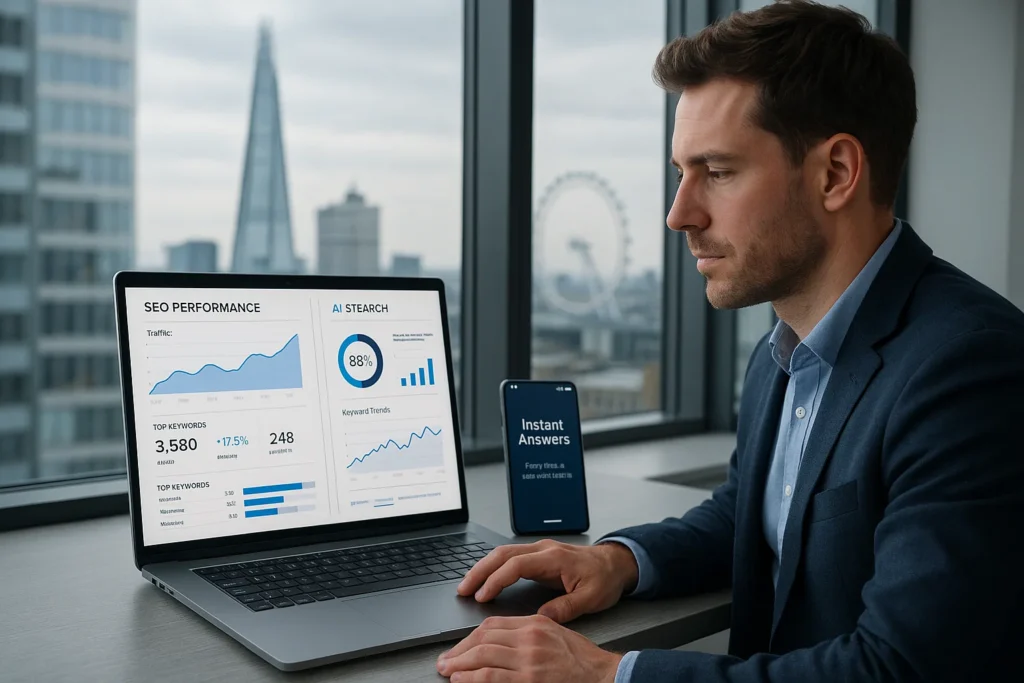
Search has changed. A lot. Users expect instant answers, assistants read the page to them, and Google’s AI summaries and rich SERP features increasingly satisfy intent without a single click.
In the UK and EU especially, more than half of searches now end without a site visit — which means the old metric of “clicks = wins” is incomplete. If we accept that reality, we can stop burning budget on fruitless paid clicks and instead build the kind of presence AI uses to recommend — which still drives revenue, loyalty and conversions (just not always via a direct click).
Below is a practical, tactical playbook for Shopify merchants, publishers and UK brands who want to capture value from zero-click search — to be the answer the assistant reads, the snippet the user trusts, and the brand that gets the conversion downstream.
Why we care: the new economics of “no click” search
Bottom line: clicks aren’t gone — they’re redistributed. Our job is to capture value across that redistribution curve.
The zero-click playbook (what to do, in order)
1) Build answer-first content (snippet-ready blocks)
Create concise, authoritative answer blocks (40–80 words) at the top of pages and guides. Use clear Q→A headings and put the direct answer immediately — then expand below with details, examples and data.
Assistants and featured snippets prefer short, direct answers surfaced in structured form.
Why it works: AI Overviews and snippets typically pull short, exact answers. If the assistant can get the answer from your page first, it will.
Quick task: For your 20 top keywords, add an H2 question and a 50-word answer at the top. Mark it with FAQ schema where appropriate.
(Citation-worthy note: answer-first pages are the most commonly quoted in voice and featured snippets.)
2) Own People Also Ask (PAA) and FAQ schema
PAA boxes are interactive and prime real estate. We create a matrix of common follow-ups for each pillar page and add them as H3 FAQs with FAQ schema (or Question schema in product pages). That increases the odds of being sourced for multiple micro-answers from one URL.
Quick task: Map 3–6 PAA questions per page and include precise answers + schema.
3) Feed AI-readers with clean structured data
Product schema, FAQ schema, BreadcrumbList, Review schema, Article schema — give the machine readable information it can digest reliably. AI Overviews and assistants prefer pages with high-quality structured metadata.
Quick task: Audit top 100 pages for schema completeness; fix missing/malformed schema first.
(Structured data meaningfully increases snippet eligibility and voice inclusion.)
4) Optimize for brand-centric zero-click outcomes
Not every zero-click outcome is bad. Knowledge Panels, Local Packs, and “As featured in” modules create discoverability and trust even without clicks. We optimise GMB/Business Profiles, entity pages, and PR signals so zero-click impressions still move the needle.
Quick task: Claim and fully optimise your Google Business Profile and Knowledge Graph signals (structured citations, Wikipedia/Wikidata where appropriate, and schema on your homepage).
5) Measure the right signals (visibility > clicks)
Switch or add KPIs:
- SERP feature impressions (Search Console + rank trackers)
- PAA/snippet visibility (use rank trackers that report SERP feature ownership)
- Assisted conversions (channels that convert after a zero-click touch)
- Brand lift & direct traffic shifts
- Revenue per impression (total revenue / SERP impressions)
Why: Publishers are seeing CTR collapse but brand visibility metrics still correlate with downstream conversions. Track impressions and assisted paths, not just clicks.
6) Repurpose into owned channels (no click → owned audience)
If an AI answer reduces a click, we still want to capture value: build email capture, SMS lists, app prompts, and social follow flows. Use the zero-click answer as the hook: “Liked the quick answer? Get the full checklist in your inbox.”
Quick task: Add an unobtrusive in-page micro-conversion (email capture) directly under the answer block.
7) Create “high-authority micro-content” for AI ingestion
Short, factual micro-pages (specs, quick comparisons, price lists, FAQ stanzas) frequently feed AI Overviews. These are low-effort, high-visibility wins if they’re accurate, structured, and authoritative.
Quick task: Publish 10 micro-pages that answer transactional FAQs (e.g., “Does product X work with Y?”) with schema and canonical tags.
8) Local & transactional zero-click flows
For local & commercial intent (store hours, booking, pricing), use structured local markup, Merchant Center, and appointment schema. The Local Pack and price/availability features often resolve intent without click — but you still win bookings if your contact/booking flows are visible in the SERP.
Quick task: Ensure live inventory feeds and Merchant Center are synced daily; add Service schema for appointments.
Creative examples we’d implement for UK brands (real tactics)
“Answer + Download” tactic: 45-word answer visible in SERP + one-click PDF checklist via email capture beneath the answer block. AI reads the answer; the user opts in for deeper value.
Local zero-click booking units: Schema + Reserve with Google setup for retail to capture bookings directly from SERP features.
Trusted snippet hub: A central “truth” page that consolidates specs, PR mentions and test results — built specifically to be the canonical answer AI cites.
Measurement framework: how to prove the ROI without clicks
- SERP feature share — % of target queries where you own snippet/PAA/Overview.
- Assisted conversions — conversions where organic impressions or branded searches appeared before conversion.
- Email/SMS signups from answer blocks — direct monetisable asset growth.
- Revenue per 1,000 SERP impressions — revenue divided by impressions (new north star).
- Brand lift surveys — micro polling to measure awareness after sustained visibility.
(Why this matters: publishers and brands report big click drops but still observe meaningful downstream revenue when visibility and trust are present.) (The Guardian)
Risks & how we mitigate them
- AI Hallucination Risk: AI Overviews can hallucinate or summarise incorrectly. Mitigation: keep authoritative source signals (PR, third-party mentions, data tables) and structured facts on your page so AI pulls reliable snippets rather than guesswork.
- Traffic volatility: When AI features expand, traffic can fluctuate. Mitigation: diversify traffic channels (email, social, partnerships) and measure revenue/assists not just clicks.
- Content cannibalisation: Multiple pages answering the same question can confuse AI. Mitigation: canonicalise and consolidate; create a single authoritative answer hub.
Quick 30-day action plan (what we do, week by week)
Audit: Top 100 queries, SERP feature ownership, schema gaps, Merchant Center check.
Answer blocks & FAQ: Implement snippet-ready answers + FAQ schema on top 20 pages.
Micro content & captures: Publish 10 micro-pages + email micro-conversions beneath answers.
Measurement & PR: Add SERP feature tracking, send 2 PR pitches to increase authority signals.
Why this saves budget (and increases revenue)
Zero-click visibility replaces expensive paid clicks with low-cost, high-trust impressions.
Instead of bidding for every query, we earn the “answer” role — that’s organic real estate that drives brand consideration, direct conversions and repeat business without continuous ad spend.
Done right, it turns search from a click marketplace into a persistent brand channel.
Frequently Asked Questions
Is zero-click bad for SEO?
No — it transforms SEO. Yes, you’ll likely see fewer clicks, but strategic visibility (snippets, Overviews, PAA) still drives conversions via brand lift, assisted paths and owned channels.
Will Google penalise sites that optimise for snippets?
No. Optimising for structured answers and honest, useful content is aligned with Google’s aim to serve users. The risk is low if content is accurate and authoritative.
How do we measure success if not by clicks?
Track SERP feature share, assisted conversions, email signups from answer blocks, revenue per impression, and brand lift. These paint a fuller picture.
Can we still use paid search alongside this strategy?
Absolutely. Use paid search for high-intent transactional queries where clicks matter, and zero-click optimisation for awareness and trust. The two work together.
How fast will this show results?
Some wins (snippet capture, schema fixes) can appear in weeks; authority and PR-driven results take months. Expect a staged improvement: fast visibility wins + compounding long-term gains.
Want us to do it for you?
We (Ladhar Enterprises) help UK brands move from “chasing clicks” to “owning answers.” We run snippet hunts, implement schema at scale, build zero-click funnels and set up the measurement stack that proves ROI.
Request a free zero-click audit: https://ladharenterprise.co.uk/ — we’ll send a short SERP-feature snapshot and a 30-day plan for your top 20 queries.